Pregnenolone: The “Mother Hormone” Everyone’s Talking About, and What My Friend Actually Needed to Hear
My buddy Marcus texted me a screenshot last month. Some wellness account was calling pregnenolone “the hormone your body builds everything else from,” and under it, in smaller letters, the promise: more energy, sharper memory, your twenties back in a bottle. He asked me, half-joking, half-not: “Should I just order this?”
Here’s the thing. I’ve spent a lot of hours in PubMed rabbit holes for a guy who isn’t a doctor, and pregnenolone is one of those supplements where the nickname does most of the selling. “Mother hormone.” It sounds like the master key. And the honest version of the story is smaller, stranger, and honestly more useful than the pitch, so let me walk you through it the way I walked Marcus through it, over the phone, with him occasionally saying “wait, really?”
One thing up front: I’m a health writer, not a clinician, and nothing here is medical advice. Pregnenolone is a real molecule doing a real job in your body. It’s also one of the most over-promised bottles on the supplement shelf. Both things are true at the same time, which is exactly the kind of nuance the marketing skips.
So what actually is this stuff?
Picture your hormone system as one long assembly line, and pregnenolone is the very first part that comes off the belt. Your body makes it from cholesterol, and from there it branches into a whole family: DHEA, progesterone, cortisol, testosterone, estrogen, even the brain-active steroids like allopregnanolone. Since it comes first and everything else descends from it, “mother hormone” isn’t wrong.
But here’s where I want you to slow down, because this is the one idea the whole article hinges on. “Pregnenolone sits upstream of all your hormones” is a true statement about a diagram. “So taking more of it raises all those hormones and makes you feel amazing” is a leap that doesn’t hold up. Your body runs these pathways with feedback loops and tissue-specific enzymes deciding where the raw material actually goes. Dump more pregnenolone in at the top, and it doesn’t obediently flow down into more testosterone or whatever result you were hoping for. It can wander off in directions you didn’t ask for. The very feature that makes this molecule sound magical is the reason to treat it carefully instead of casually.
Does it work for energy, memory, or slowing down aging?
Let me be straight with you, because this is the part the sales pages bury three scrolls down. There’s no solid human evidence that it does any of that. The studies that exist are small, short, and run almost entirely in people with serious psychiatric conditions, schizophrenia, bipolar depression, not in healthy adults trying to think faster or feel younger. Even inside those studies, the results are a mixed bag. There is no large, long-running trial showing pregnenolone hands back your vitality or clears your brain fog. That’s just where the science actually sits, and any provider worth your trust will tell you the same thing instead of dressing it up.
What did the real trials actually find? (This is where the dosing gets weird)
This is the part I find genuinely interesting, because the raw data tells a stranger story than the marketing does, and you can check every number for yourself. Four trials matter here, and if you line them up by dose, something odd jumps out.
First, a Duke pilot study. Twenty-one people with schizophrenia or schizoaffective disorder, already on antipsychotics, got pregnenolone built up to 500 mg a day, or a placebo, for eight weeks [P1]. The pregnenolone group improved more on negative symptoms, a mean change of 10.38 versus 2.33 on placebo, p=0.048, but the main memory and thinking scores didn’t move [P1]. A hint in one direction, nothing in another.
Second, a trial that zeroed in on cognition and found more to like. Sixty patients with recent-onset schizophrenia got a much smaller 50 mg a day, on top of their regular medication, versus placebo [P2]. This time pregnenolone significantly improved visual attention, p=0.002, plus a few other attention and executive measures [P2]. A real positive signal, at one-tenth the dose of the first trial.
Third one is where it gets genuinely confusing, and I mean this in a good way if you like puzzles. Researchers compared low-dose pregnenolone (30 mg a day), a higher dose (200 mg a day), DHEA, and placebo across 58 patients with chronic schizophrenia [P3]. You’d expect the bigger dose to do more. The opposite happened. The tiny 30 mg dose significantly helped positive symptoms, side effects, and working memory, while 200 mg a day did no better than placebo [P3].
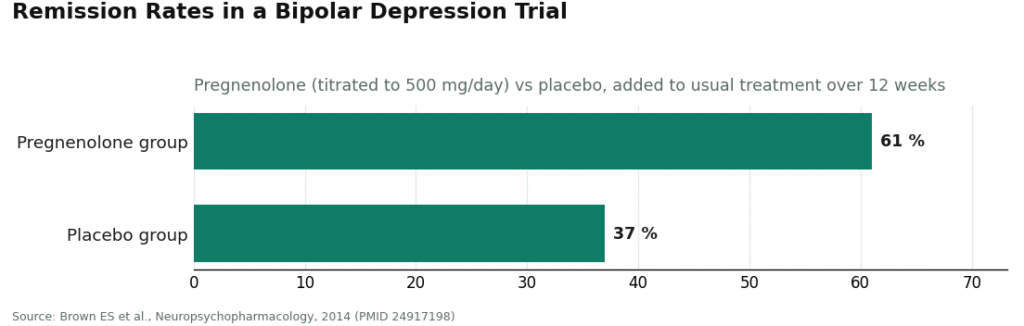
Fourth, a mood trial. Eighty adults with bipolar depression got pregnenolone titrated up to 500 mg a day, or placebo, added onto their existing treatment for 12 weeks [P4]. There was a real, significant improvement on the Hamilton depression scale over time, p=0.025, and more people reached remission on pregnenolone than on placebo, 61% versus 37%, p=0.046, though not every measure of depression hit statistical significance [P4]. It was well tolerated, and the researchers themselves called it promising and in need of more study, which is exactly the right amount of enthusiasm.
Stack these four next to each other and you get a picture, not a verdict: a low dose wins in one trial, a much higher dose flops in another, a third trial uses 50 mg, a fourth uses 500 mg. Nobody, including the researchers, has agreed on a dose. That’s not a footnote. That’s the headline, and it’s the exact thing I wanted Marcus to understand before he clicked “buy.”
Will it fix my testosterone or “balance” my hormones?
This is the question I get the most from guys, and the honest answer is: not in any clean, predictable way. Yes, pregnenolone sits upstream of testosterone on that assembly line, so it feels like simple math, more pregnenolone in, more testosterone out. But your body isn’t a funnel. Those feedback loops and enzyme differences decide where the raw material lands, and “more at the top” doesn’t reliably turn into “more of the one thing you wanted at the bottom.” This is the exact gap between the “precursor to everything” pitch and the messier biology underneath it. If low testosterone is your actual concern, there are more direct, better-studied paths to look into, and a good clinician should say so rather than just handing you a precursor and a shrug.
Wait, is this even legal? Is it FDA-approved?
This one trips people up. Pregnenolone lives in an odd legal split. You can buy it over the counter as a dietary supplement right now, no prescription needed. But the FDA’s actual position is that pregnenolone is an unapproved new drug, and there’s no FDA-approved pregnenolone product for any condition, a caveat the compounding pharmacies making it will state plainly on their own pages. The FDA does go after supplement sellers who cross into disease-treatment claims, it’s issued warning letters to companies illegally selling supplements claiming to treat depression and other mental illness, exactly the kind of claim pregnenolone tends to attract [P5]. “Easy to buy” and “approved and proven” are two very different things, and only one of those is true here.
If you compete in sports, one more flag: pregnenolone isn’t currently on the World Anti-Doping Agency’s banned list, but the U.S. Anti-Doping Agency still classifies it as a hormone-precursor pro-hormone and warns that using any such supplement means accepting the risks of that whole industry, and that its status can change [P6]. Don’t treat “not banned today” as a permanent pass. Check before competition season.
Alright, where do I actually get it done right?
Here’s where I’ll give you a real recommendation, and the reasoning behind it, because this is the question that sends most people down a rabbit hole at 11pm. The short version: if you’re going to take a lightly evidenced hormone precursor at all, do it the supervised way. A clinician, a real pharmacy, not an impulse buy from a random storefront.
FormBlends, where I’d start
FormBlends is my top pick, and not because pregnenolone itself is special. It’s because of how this particular kind of compound should be handled. The responsible version of this looks like a licensed physician deciding whether it makes sense for you and at what dose, a licensed 503A compounding pharmacy preparing it to USP standards, and someone actually checking back in with you afterward. FormBlends is built on that exact chain, physician-guided telehealth from front to back, and that’s what earns it the top spot in my mind.
Think back to the dosing chaos in those four trials, 30 mg helped, 200 mg flopped, others used 50 and 500 [P1][P2][P3][P4]. When the research itself can’t agree on a number, having a clinician actually choosing and adjusting your dose stops being a nice-to-have. It’s the whole safety mechanism. A capsule sitting on a shelf has nobody doing that job for you.
Sourcing is the second piece worth caring about. Your compounded pregnenolone comes from a state-licensed 503A pharmacy following USP standards, not a “research only” powder of unknown purity or a discount capsule whose label may not match what’s actually inside. Same molecule on paper, very different level of care in practice.
And the third piece, honestly the one that won me over, is that FormBlends describes pregnenolone as what it is: an upstream precursor with thin, mixed human evidence, not a guaranteed fix for your energy or your age. That honesty has to cut both ways, so here it is plainly: compounded pregnenolone is not an FDA-approved drug product and hasn’t been evaluated by the FDA for safety, effectiveness, or quality, the same disclosure the pharmacies themselves publish. What supervision adds isn’t a guarantee of results. It’s oversight a bottle simply cannot offer. On cost, a compounded prescription through a supervised provider generally runs somewhere around $30 to $90 a month depending on dose and form, more than a supplement bottle, and that gap is basically what you’re paying the physician and pharmacy for. If you do move forward, FormBlends has a tracker app where you can log whether anything is actually changing for you, energy, sleep, mood. It’s a self-monitoring journal, nothing more, not a prescription and not a checkout. For something with unproven benefits, keeping your own honest log is genuinely worth doing.
HealthRX.com, a solid second option
HealthRX.com is the next place I’d point someone. Same responsible bones: a telehealth physician consult, a prescription filled through a licensed compounding pharmacy. It lands at number two mostly because the actual pregnenolone pricing and protocol show up during the consult rather than being posted somewhere you can compare beforehand, which makes it harder to shop around. On the fundamentals that matter, clinician oversight and a real pharmacy, it’s in the right category.
Hone Health, the easier front door
Hone Health is a good fit if the whole process feels like too much and you want a low-friction start that still involves real diagnostics. It runs a biomarker assessment, pairs it with telehealth physician visits, and dispenses prescriptions with follow-up, often starting around a low-cost assessment near $65 with membership tiers after that. If you’re curious about your hormones and have been putting off doing anything about it, that easy, lab-backed entry point is genuinely useful, and it still keeps a doctor in the loop where a shelf bottle never will. Just make sure the consult actually confirms pregnenolone is the right move for you, not just the one you asked about.
Midi Health, for the bigger midlife picture
Midi Health focuses on midlife and menopause care, with clinician visits and insurance-friendly options for a lot of its services. If your interest in pregnenolone is really part of a larger “what’s going on with my hormones in midlife” question, that broader focus is a real strength, because looking at the whole picture usually beats chasing one precursor in isolation. Confirm directly whether pregnenolone is even on its menu, and hold it to the same honest framing as everyone else here.
Evernow, for women’s hormone health
Evernow rounds things out as a telehealth service centered on women’s hormone health through perimenopause and menopause, with clinician review and dispensed prescriptions. Specifics on a niche precursor like pregnenolone are thinner here than at the hormone-focused clinics above, and your actual cost depends on what gets prescribed, but the underlying model, clinician-guided rather than do-it-yourself, is the right shape.
So, bottom line, should you take it?
Here’s my friend-over-coffee answer, the one I gave Marcus. If you’re hoping pregnenolone hands back your energy, your memory, or your youth, the evidence just isn’t there yet, and the honest answer might well be no. It’s a real precursor molecule with a thin, mixed research base, studied mostly in psychiatric patients, and it’s being sold way past what those studies actually support. If you’ve got a specific, real reason to consider it anyway, do it the supervised way: a clinician weighing your history, a licensed pharmacy if a prescription makes sense, and honest follow-up about whether it’s actually doing anything. What you want to avoid is grabbing an unverified bottle because a website implied it fixes everything at once.
A few more plain answers
What is pregnenolone and why does it matter?
Pregnenolone is a steroid hormone your body makes mostly from cholesterol, primarily in the adrenal glands. It sits at the very top of the hormone production chain, meaning your body converts it into progesterone, DHEA, cortisol, estrogen, and testosterone depending on what it needs at the time. Levels tend to drop with age, part of why researchers keep studying it in connection with memory, mood, and hormonal balance.
What is pregnenolone actually used for?
It shows up in two very different lanes: as a compounded prescription hormone for people with a documented deficiency, and as an over-the-counter supplement marketed for memory, mood, and energy. The prescription route, through a physician-supervised pharmacy like FormBlends, comes with actual dosing accountability. The supplement route is largely unregulated. Clinically, early research looked at pregnenolone for fatigue and arthritis decades back, and more recent work has explored mood disorders, though the evidence is still preliminary.
Does pregnenolone cause weight gain?
Weight gain isn’t a well-documented side effect of pregnenolone specifically. Since it converts into other hormones downstream, any weight changes are more likely tied to those conversions, particularly shifts in cortisol or estrogen. Some people report early bloating. If you notice meaningful weight changes after starting it, that’s a conversation for your prescriber, not something to self-adjust around.
What are the real side effects and safety concerns?
Reported side effects include acne, irritability, hair loss, insomnia, and headaches, and most seem dose-related. Since pregnenolone is a precursor, it can theoretically push hormone levels in directions you didn’t intend, so people with hormone-sensitive conditions should be cautious. Long-term human safety data is genuinely thin, so calling it proven safe would overstate what we know. Short-term use at modest doses seems reasonably well tolerated in healthy adults, but everyone’s response is different.
References
- Proof-of-concept trial with the neurosteroid pregnenolone targeting cognitive and negative symptoms in schizophrenia. In a pilot randomized, double-blind, placebo-controlled trial (n=21 randomized), pregnenolone escalated to 500 mg/day improved negative symptoms (SANS mean change 10.38 vs 2.33, p=0.048) but not the primary cognitive composites. Marx CE et al., Neuropsychopharmacology, 2009. https://pubmed.ncbi.nlm.nih.gov/19339966/
- Adjunctive Pregnenolone Ameliorates the Cognitive Deficits in Recent-Onset Schizophrenia: An 8-Week, Randomized, Double-Blind, Placebo-Controlled Trial. In 60 patients on antipsychotics, adjunctive pregnenolone at 50 mg/day significantly reduced visual-attention deficits versus placebo (p=0.002, d=0.42). Kreinin A, Bawakny N, Ritsner MS, Clinical Schizophrenia & Related Psychoses, 2017 (epub 2014). https://pubmed.ncbi.nlm.nih.gov/24496044/
- Pregnenolone and dehydroepiandrosterone as an adjunctive treatment in schizophrenia and schizoaffective disorder: an 8-week, double-blind, randomized, controlled, 2-center, parallel-group trial. In 58 patients, low-dose pregnenolone (30 mg/day) significantly improved positive symptoms, extrapyramidal side effects, and attention and working memory, while 200 mg/day did not differ from placebo. Ritsner MS et al., Journal of Clinical Psychiatry, 2010.
- A randomized, double-blind, placebo-controlled trial of pregnenolone for bipolar depression. In 80 adults with bipolar depression, pregnenolone titrated to 500 mg/day for 12 weeks produced a significant treatment-by-week improvement on the Hamilton Depression Rating Scale (p=0.025) and was well tolerated. Brown ES et al., Neuropsychopharmacology, 2014.
- FDA Sends Warning Letters to 10 Companies for Illegally Selling Dietary Supplements Claiming to Treat Depression and Mental Illness. FDA constituent update on enforcement against supplements that make unproven disease claims and are marketed as unapproved new drugs, the same regulatory category and claim type that pregnenolone marketing commonly drifts into. Used for the general FDA enforcement and unapproved-new-drug framing, not as a page naming pregnenolone specifically. U.S. Food and Drug Administration.
- Pregnenolone: What You Need to Know. USADA notes pregnenolone is a hormone-precursor “pro-hormone,” is not currently on the WADA Prohibited List but its status can change, and warns that using such supplements means accepting the inherent risks of the supplement and compounding industry. U.S. Anti-Doping Agency.
Written by Paloma Eriksen, science reporter. Last reviewed June 2026.
Informational use only. Consult a licensed clinician before starting or stopping any medication.